
A Fortuitous Morning
A Pilgrim's Tale — from 'The Long Way In'

This is an excerpt from my ongoing series The Long Way In, a pilgrimage where I visit the sacred spaces of my home city, Ōtautahi Christchurch.
Bishopdale — one of those pedestrian-only open-air malls built back in the ‘60s and largely unchanged since then. There’s a fish and chips shop, a dairy, a second-hand clothes store. A little after eight in sleepy suburban Christchurch on a Sunday morning — and apart from an old man whizzing by on his mobility scooter there’s no-one else about.
It might seem a strange place to find it, but hidden behind this glass storefront whited out from pedestrian onlookers is the Sri Ganesha Temple. The sign out the front displays their website and open times: not too dissimilar to the hairdressers next door.
Just after 8.30 a man and a woman walk on past, take off their sandals and shoes at the front doors, and slip inside. There’s the sounds of what might be chanting coming from within — it’s hard to tell from outside. I can’t help but feel apprehensive — unsure of how these next few hours will play out.
Another couple are taking their shoes off at the door. Taking this as my cue, I slip off my boots at the door — below a sign reading, ‘Caution: beware of shoe thieves!’ — and follow them inside. It’s a low-ceilinged room with bright overhead lighting, maybe twelve by twelve metres or so. At the back of the room is a little kitchenette and a door heading off to a bathroom — on the left-hand wall walking in is a row of plastic chairs and before these some coloured mats on the floor.
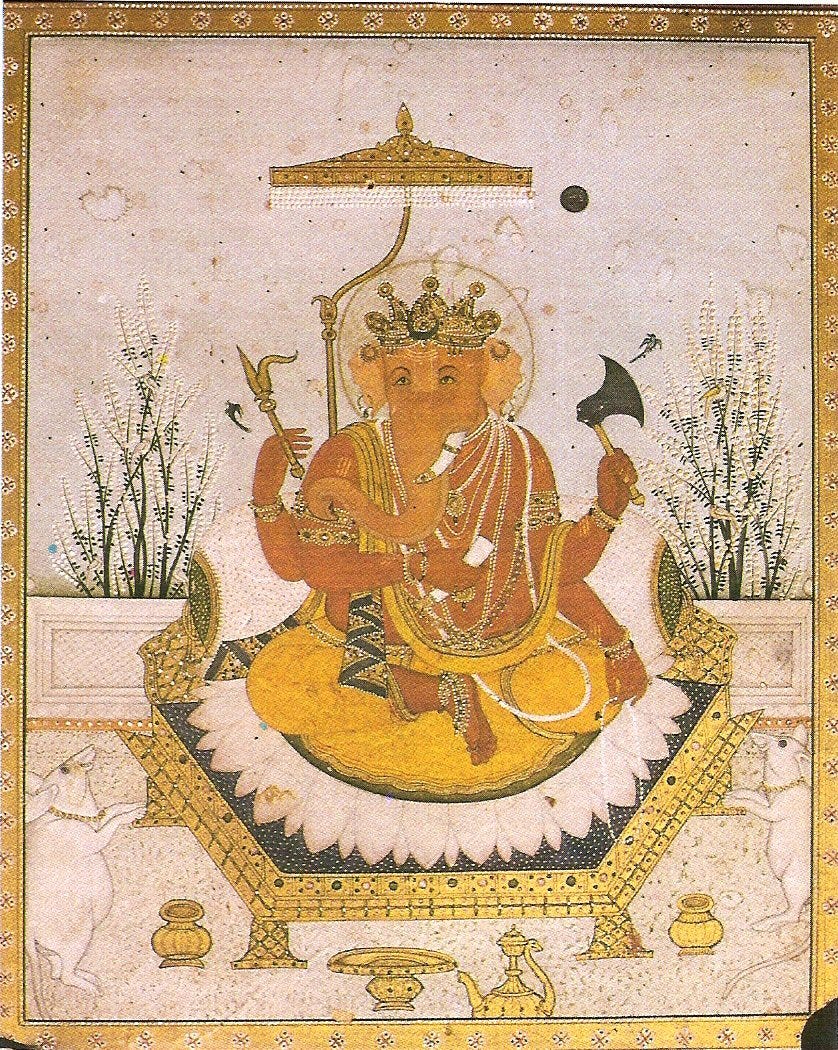
But all of this is background scenery to the main focus of the room: the sanctum (the garbhagṛha or ‘womb-house’) reaching right up to the ceiling — almost like one of those old four-poster bed-frames complete with curtains pulled back to reveal the ebony-dark mūrti (or statue) of the four-armed, elephant-headed Lord Ganesha himself. He’s resplendently garlanded with bright flowers, and before him a pūjāri — a priest — is already preparing the space, chanting as he does so.
I take a seat along the back wall. There are a couple of other, smaller shrines too — these tucked in behind and to the left and right of the main Ganesha sanctum. To whom these shrines are dedicated I don’t know: I don’t recognise any defining features on the various mūrti, each intricately cast in bright silvers upon tables similarly overflowing with coloured fabrics, flowers, incense, and lit oil lamps.
I feel a little out of place as more people enter from both the storefront doors as well as the back door by the kitchenette. There’s the pūjāri, still chanting, flicking water and dropping flowers upon the mūrti of Lord Ganesha; people in the kitchen preparing bowls and filling pots; families spread out on the floor mats slicing up bananas and placing them on plates. A few people catch my eye and we exchange smiles, but for the most part people seem intent on going about their own business, leaving me to sit and watch.
Yet more and more filter inside: old, young, men, women, children, babies. Some sit cross-legged on the floor, others in the row of chairs along the back row, while an increasing number stand as the pūjāri moves now from Ganesha to the other shrines, chanting and blessing as he goes. His last act at each shrine is to take a lit oil lamp, pass it over the mūrti with tender care and attention, and finally to turn to the gathered in a sort of offering of the flame. Each time he does so, everyone lifts up their hands in a symbolic catching of the flame, passing their hands over their head as they do so — a transference of the sacred flames’ life and warmth.
The place is awash with noise — as well as the general hum of the gathered conversing among themselves, there’s the pūjāri still chanting, the ringing of bells, and even recorded music coming from a portable speaker-stack. Everywhere I look is bright colour — the bright saris of the women, garlands of marigolds on every shrine, even the toddlers dressed up in their best. English is only spoken as way of communicating between the many different Indian languages; I’m the only white face in this packed room of maybe fifty or sixty people. Chaotic as it might initially appear to an ignorant onlooker like myself, everyone seems to know exactly what is happening, and are eagerly anticipating whatever is about to come.
There’s a sudden lull: the priest seems to have finished his blessings of the various mūrtis. An attendant — not a priest, exactly, but clearly a well-known and senior member of the community — calls out to the gathered, asking those who brought along a something called a ‘kavādi’ to get themselves ready.
This gets the crowd moving — children and adults alike from among the gathered spring to their feet and assemble by the sanctum, lifting off the floor curious semi-circular wooden objects decorated with flowers and small icons of various gods. Clearly these are the kavādi: hoisted over one shoulder they are carried in a procession first clockwise around the central sanctum to Lord Ganesha, and then outside and into the sunshine. I remain with the others watching the procession: even the portable speaker stack is being wheeled along, blasting out thumping bass as part of the general chanting and noise. I notice one old lady (complete with zimmer frame) looking on with an expression of utter confusion on her face.
The procession winds back inside, the kavādi are taken away — everyone resumes their places. I find a cosy spot on the floor with a good view of the proceedings.
First up is the abhiṣeka — the ritual bathing: the pūjāri takes great metal pots filled with milk and clear and coloured water and pours them over the assembled mūrti within the sanctum — not Lord Ganesha himself, but his companions or attendants. Fresh fruits, flowers, rice, and various sweets are offered — and pot after pot of liquid. (Later, I am able to sneak a peek at the sanctum, and see that it’s lined and watertight — otherwise we assembled on the floor would be getting soaked!) All the while there is singing, chanting, drums and bells — and, as an entertaining reminder of which century we’re all in — people taking out their phones to film: I spot one person livestreaming their camera feed on Facebook!
After abhiṣeka, the curtains to the sanctum are closed (allowing the pūjāri and his various attendants time to clean and mop up all the liquid); meanwhile a table is placed between us and the curtained-off sanctum and a screen is placed before that, cutting us off from seeing what’s happening. In the meantime, a microphone is passed around the crowd: devotional songs are sung alongside often polyrhythmic drums and bells. Whatever is happening behind the screen is taking some time — the curtains of the sanctum are re-opened and now the pūjāri can help out.
Finally the screen is withdrawn — revealing those same mūrti that had been doused in liquids during the pūja now elaborately decorated with fresh fruits, flowers, and yet further decorations. The pūjāri now repeats the same procedure before this shrine as he did earlier before the others, concluding with multiple offerings of the sacred flame — each time we receive it with open hands. To conclude, the pūjāri takes some of the sacred water he’d been dashing onto the mūrti and turns to dowse the crowd with it — I get a good splash across the forehead: very auspicious!
The community leader who had spoken earlier now addresses us, thanking us for our presence, and inviting us all forwards. We all stand, pressing close on one another, heading in the direction of the pūjāri still standing before the shrine with the lit lamp of the sacred flame in his hands. I watch as those before me approach him, holding their hands out before the flame and then moving their hands over the heads; from three small bowls of what appear to be chalks they take a finger and leave a coloured dot or line — a tilaka — on their foreheads.
Then it’s my turn: I bow my head in recognition of the pūjāri, who (perhaps recognising my inexperience) guides me through the process. I choose white powder for my own forehead — although in comparison with the artful applications of those around me, I can’t help but feel my own tilaka is somewhat lacking!
Two more attendants then spoon a dash of milk into my outstretched right palm — I knock that back in time for the next to spoon stewed banana in its place. I do my best to eat that as tidily as I can, and am swept on forwards with the crowd in a clockwise movement around the Ganesha sanctum, pausing for prayers at the other shrines.
As the crowd starts to dissipate, heading their separate ways, I notice the clock on the wall, and realise I’ve been here for nearly four hours. My head’s a-whirl, my ears still hear the echoes of ringing bells and chants, there’s the taste of banana on my tongue and the smell of incense permeating my clothes. I can’t say exactly what I’m feeling, other than the comedown of a sensory overload. Bowing my head in thanks to the pūjāri as I leave, I shoulder my bag and head on my way…
Read more from ‘The Long Way In’ below —

So, no one talked to you, welcomed you or asked why you were there?