
Becoming Tree-ish
Or, "Which Way Is Up?"

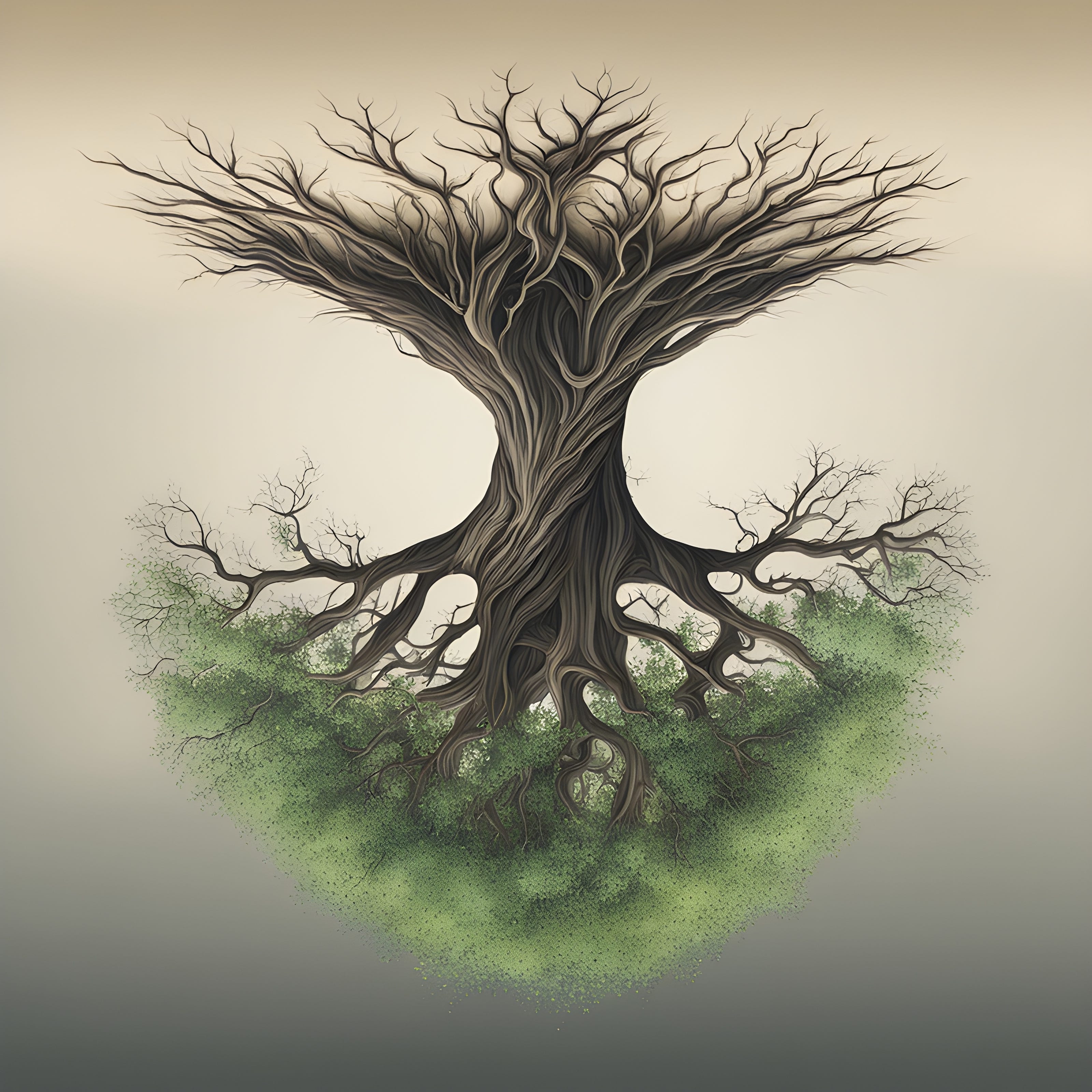
I have always for some reason - I don't know why - been enormously attracted by trees… I suppose I have some simple-minded form of longing; I should have liked to have been able to make contact with a tree, and find out what it feels about things.
J.R.R. Tolkien, BBC Interview, 1968
Like Tolkien, I’ve often wondered what life as a tree would be like - what a tree might ‘experience’. We’re surrounded by plants, everywhere we go - even if we live in cities - but it’s easy to take it for granted. They’re just part of the scenery: the grass we walk upon, the trees we walk under, the weeds growing in the cracks in the pavement. Plants are so foreign to us that while we can recognise that they’re living beings just like we are, it’s hard to recognise just what that life might feel like.
It’s comparatively much easier for us to relate to an animal - even animals that are quite different to us. We share with animals many similarities: movement; senses like vision, touch, hearing; ingestion of food. Plants, meanwhile, are completely different to us in all those key ways - they don’t move like we do, they don’t share our senses as ways of interacting with the world, and they photosynthesise instead of eating. It’s hard for us to relate - to bridge the experiential gap.
The major problem we face is that our animalistic mode of interacting with reality acts as a set of blinkers, shielding us from the possibility of recognising alternatives. If we really want to be like a tree, we’re going to have to take a few creative leaps of the imagination.
So then - let us leap. To do this, I’ll ask you a question: which way is up?
The answer is surely obvious: up is, well, up - towards the sky and away from the earth. Down, correspondingly, is towards the ground and away from the sky.
(Of course, up and down as words are not just directional - they are qualitative, too. To move up in the world has a positive connotation, as does being top of the world. The sky is the domain of God; it is the quest of humanity to ascend to the stars and colonise the galaxy. Down, meanwhile, is all negative: hellfire, and the grave. All this has unique ramifications on the way that we view and interact with reality, but, as we shall see, this is a unique feature of the specifically human experience.)
It’s clear why we think this way. The human operating system - not just our brain but our eyes, ears, mouth, and nose - through which we interact with reality is located at the top of our bodies. We (the enlightened masters of reality) literally look down upon the world. But this is only a perspective, and if we are to flip that perspective - up is down - we can start to see things a little more tree-ishly.
Consider gravity. From a human perspective gravity tethers us, keeps us in place - it is a restricting force. Yet throw something up into the air and it will fall to the ground - for gravity is also an attracting force: it draws mass to it. As a tree, then, we have the innate desire not to strain against gravity but to grow towards it.
It is easy to forget that what we see of trees - the trunk, the branches, the leaves - is something like a mirror image of that which is underneath: the roots. In our human way of perceiving we think of the visible parts of the tree as the important parts - the leaves are where photosynthesis takes place, and the flowers are where reproduction happens. But for a tree these are simply a large set of lungs and genitals dangling in the abyss, and meanwhile the really important parts are below ground. For the roots are not just anchors - they are the structures that intake water and minerals; they are even a sort of (tree-ish) neural network. A tree has no ‘brain’, as such, but a tree’s seat of experience - or consciousness, if we want to use that word - is here, among the roots.
Seeing it this way the soil becomes a rich intermingling of all sorts of life, replete with competition, communication, co-operation. With a tree’s axis of orientation towards gravity, it is the innate goal of the tree to reach deeper and deeper into the ground - and in doing so bringing it into contact with other plants and fungi. While humans experience as individuals, a tree experiences as part of a wider collective, co-mingling with others - something akin to a communal consciousness.
When we look back at ancient religious and wisdom traditions regarding Mother Nature, this is the narrative that emerges - collectivism, and a recognition of the interconnectedness of all beings. No doubt early peoples that lived life so entangled with nature would have been more able to connect with (and understand) plants from a plants’ own perspective. These early peoples would have had no other choice: plants were food, clothing, shelter - even spiritual guides. But our increased technological and cultural capabilities as a species have acted to strengthen the blinkers that hold us tight within our anthropocentric perspective - to our detriment. We humans are uniquely unsatisfied creatures, always seeking new heights, always striving upwards, always struggling against our constraints. No doubt these unsatisfactions are built out of our perspective on reality - and I don’t think a tree has those problems, because they have a perspective of their own.
I’ll never get to experience life as a tree. But trying to break free from the restrictions of our human perspective is valuable: it teaches us a sense of humility, that there are other ways of looking at the world that we can then bring back to inform our own experiences. Perhaps if we want to live more peaceful, satisfied lives, we should all try to be a little more tree-ish.